With the continued rise in the new electric vehicle market, plug-in hybrid B-segment cars, with their flexibility of being both gasoline and electric, have become a preferred choice for family use and commuting. Recently, DONGFENG NISSAN launched the 2026 NISSAN N6 plug-in hybrid version as a rising star among Japanese brands, directly competing with the domestic benchmark 2026 BYD Qin L DM-i. One is a joint venture brand emphasizing comfort and technology, while the other is a domestic brand known for its cost-effectiveness. Which car is superior? This article will provide an in-depth comparative analysis based on comprehensive online information, covering multiple dimensions such as price, configuration, design, safety, intelligent driving, and applicable scenarios.
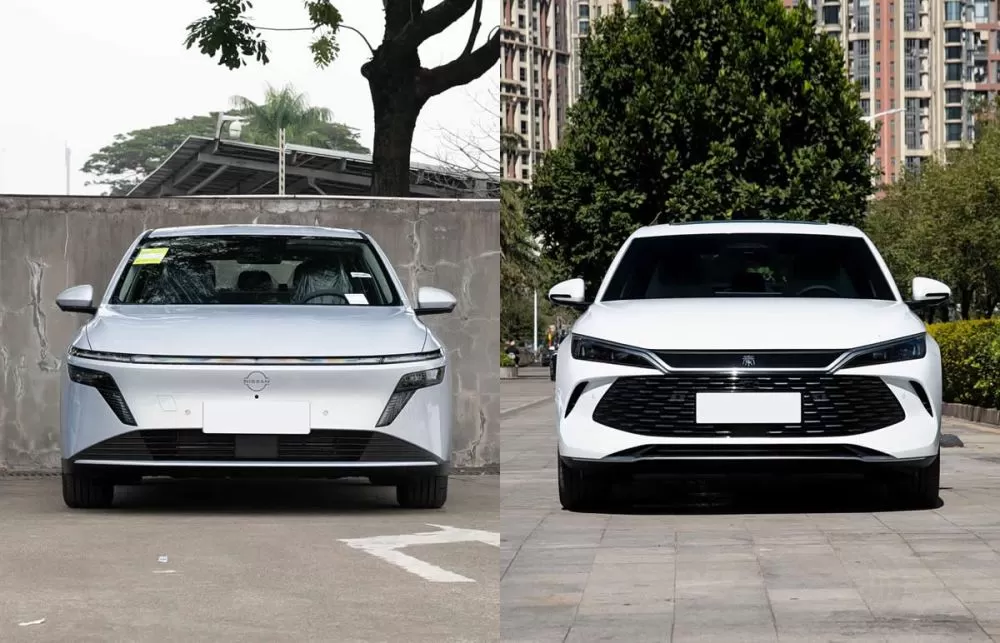
From the official pricing, both cars are anchored in the popular 100,000-130,000 yuan family sedan range, but their strategies differ slightly.
DONGFENG NISSAN N6: Official guide price is 99,900-129,900 yuan. Recently launched with a limited-time special offer, the starting price is as low as 91,900 yuan, offering outstanding value for money. Multiple configuration versions are currently available, with the high-end model equipped with CATL batteries and advanced driver assistance systems.
BYD Qin L: Official guide price ranges from 96,800 to 153,800 yuan. Both new and old models are sold concurrently, with as many as 14 models available, offering a wide range of choices. After terminal discounts, the entry-level price can be as low as around 80,800 yuan, making it even more affordable.
Summary: The Qin L has an advantage in terms of price range breadth and absolute entry-level price, providing more choices for budget-sensitive users; while the NISSAN N6, with its limited-time discount and starting price of less than 100,000 yuan, demonstrates the sincerity of joint venture brands, with a more focused pricing strategy.
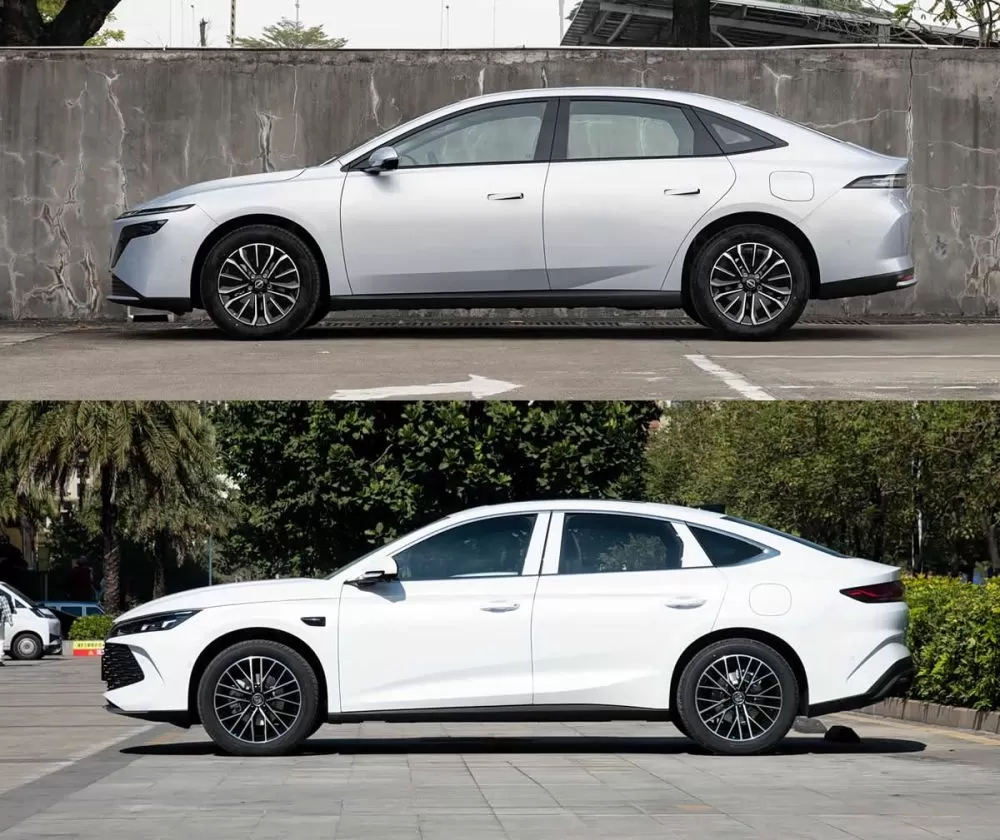
In terms of design, the two cars have distinct styles, catering to different aesthetic preferences.
NISSAN N6: The exterior combines Japanese refinement with the technological feel of new electric vehicles. The front features a star-ring style continuous light cluster and a closed grille, with uniquely designed split headlights that are highly recognizable. The body lines are smooth, with a drag coefficient as low as 0.248Cd. The waistline extends elegantly to the rear, complemented by a small ducktail spoiler, giving it a sporty and stylish look. Its dimensions are 4831/1885/1491mm, with a wheelbase of 2815mm, classifying it as a standard mid-size sedan. The trunk capacity reaches 570L, offering practical space.
The BYD Qin L continues the family's classic "Dragon Face" aesthetic design. A large chrome-plated dot-matrix grille connects to sharp LED headlights, while illuminated "dragon whiskers" and the "Qin" logo exude power. The side profile features a sculpted waistline, and the continuous taillights blend oriental charm with modern style. Its dimensions are 4830/1900/1495mm, with a wheelbase of 2790mm. Wider and taller, it offers superior lateral and headroom, and the rear seats can be folded down in sections for good expandability.
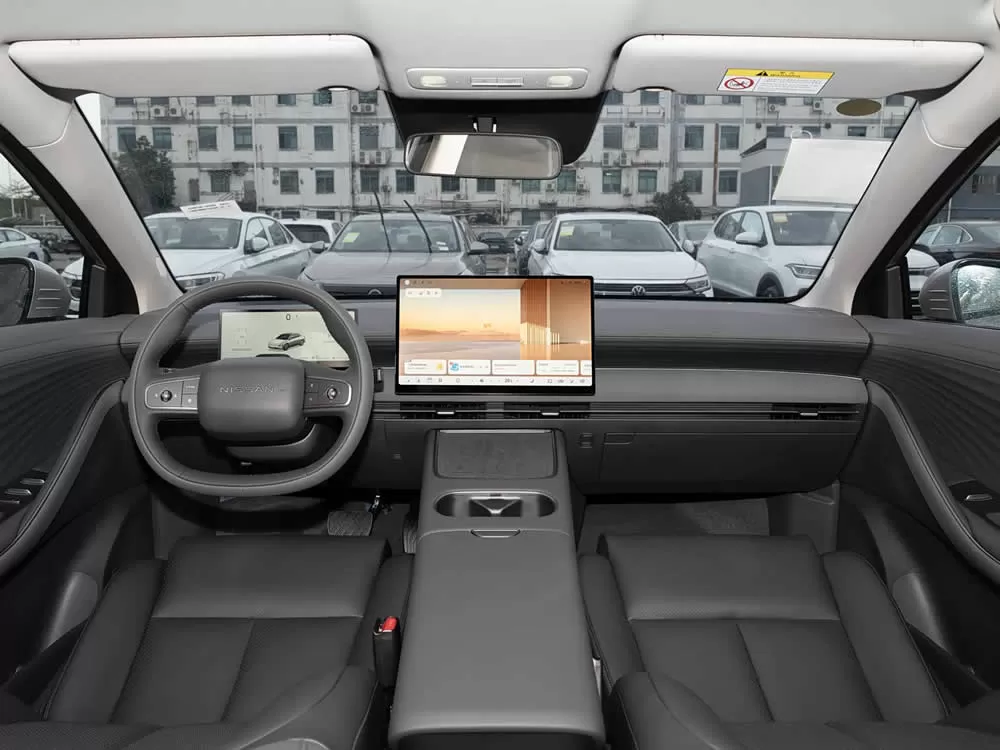
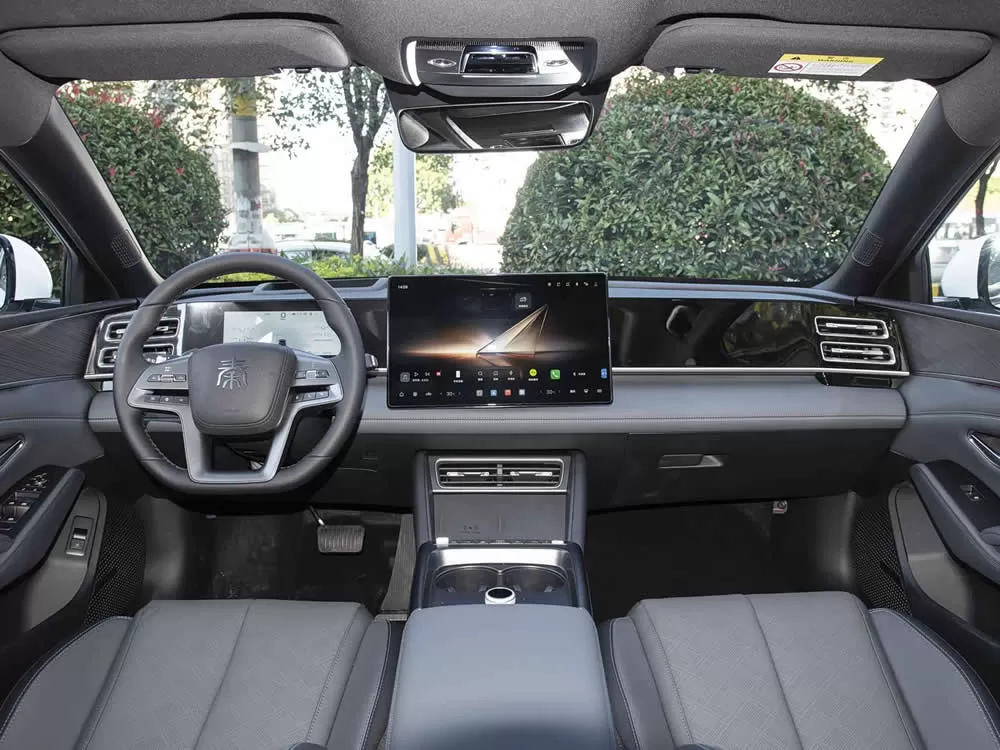
The cabin atmosphere and intelligent experience are important considerations for modern car buyers.
NISSAN N6: The interior features a minimalist and technological style, with a wraparound layout, a floating full LCD instrument panel, and a large central control screen. All models come standard with an electronic gear selector and a two-spoke steering wheel. Lower and mid-range models feature a 10.25-inch instrument panel + 14.6-inch 2.5K screen and a Qualcomm Snapdragon 8155 chip; higher-end models upgrade to a 15.6-inch 2.5K screen and a more advanced Qualcomm Snapdragon 8775 chip, ensuring smooth operation. The system supports HUAWEI HiCar, four-zone voice interaction, and in-car karaoke. Some models are equipped with AI zero-pressure cloud carpet seats, supporting 12-point massage, ventilation, and heating, maximizing comfort features.
BYD Qin L: The interior is inspired by Chinese landscape paintings, creating a "landscape painting-inspired cabin." All models come standard with an 8.8-inch instrument cluster and a 12.8-inch (15.6-inch on higher trims) central control screen, featuring the DiLink intelligent connectivity system, supporting dual-zone voice control, OTA upgrades, remote smartphone control, and DeepSeek large-scale model access. All models feature leather seats; mid-to-high trims offer heated/ventilated front seats, while higher trims also include a head-up display (HUD) and a car refrigerator.
Further vehicle configuration comparisons for these two models are shown in the table below:
|
Comparison Items |
2026 Dongfeng Nissan N6 Plug-in Hybrid |
2026 BYD Qin L Plug-in Hybrid |
|
Vehicle dimensions (length/width/height, mm ) |
4831 / 1885 / 1491 |
4830 / 1900 / 1495 |
|
Wheelbase (mm ) |
2815 |
2790 |
|
Powertrain |
AI Cloud Hybrid System (1.5L Engine + Single Motor) |
Fifth-generation DM-i Super Hybrid Technology (1.5L engine + electric motor) |
|
Engine maximum power |
75 kW |
74 kW |
|
Peak power of drive motor |
155 kW |
120kW / 160kW / 175kW (different versions) |
|
0-100km /h acceleration time |
6.8 seconds |
Fastest 7.5 seconds |
|
Battery type and capacity |
21.1kWh lithium iron phosphate battery |
15.87kWh or 25.28kWh blade battery |
|
CLTC pure electric range |
180 km |
128 km or 210 km |
|
CLTC /NEDC fuel consumption when the battery is low |
2.79 L/100km |
2.79 L/100km |
|
Combined driving range |
Not explicitly mentioned |
up to 2110 km |
|
Fast charging power |
Supports 42kW fast charging |
23 kW fast charging |
|
Interior and screens |
Mid-range and low-end models:
10.25-inch instrument cluster + 14.6-inch 2.5K central control screen; |
All models feature an 8.8-inch instrument cluster and a 12.8-inch (15.6-inch for higher trims) central control screen. |
|
In-vehicle infotainment chip |
Mid-range/low-end configuration:
Snapdragon 8155; |
Not explicitly mentioned |
|
Smart interconnection |
Supports HUAWEI HiCar, dual-zone voice control, smartphone car control, in-car karaoke, etc. |
Built-in DiLink system, supports dual-zone voice, OTA, mobile APP control, and DeepSeek access. |
|
Seating configuration |
Some models support seat heating, ventilation, and massage (driver's seat). |
All models feature leather seats; mid-to-high trim levels include heated/ventilated front seats. |
|
Other unique features |
Electronic column shifter, two-spoke steering wheel, 50W wireless charging, 12 speakers |
Higher-spec models offer a head-up display (HUD), 50W fast charging for mobile phones, and a car refrigerator. |
|
Trunk volume |
570 L |
Specific data has not been released, but the rear seats can be folded down in a 4/6 split. |
|
Official price range |
99,900 - 129,900 RMB |
96,800 - 153,800 RMB |
As plug-in hybrid vehicles, the powertrain and energy consumption are crucial.
NISSAN N6: Equipped with the AI Cloud Hybrid System, consisting of a 1.5L naturally aspirated engine (75kW maximum power) and a 155kW electric motor, paired with a 1-speed DHT transmission, achieving 0-100km/h acceleration in 6.8 seconds. The CLTC features a 21.1kWh lithium iron phosphate battery (high-end models use CATL batteries), offering a pure electric range of 180km. It supports 42kW fast charging, charging from 30% to 80% in just 17 minutes. The CLTC boasts a fuel consumption as low as 2.79L/100km when the battery is depleted, demonstrating excellent fuel economy.
The BYD Qin L, equipped with fifth-generation DM-i super hybrid technology, features a 1.5L engine with a maximum power of 74kW, and electric motors available in 120kW, 160kW, and 175kW versions. It achieves a 0-100km/h acceleration time as fast as 7.5 seconds. With either a 15.87kWh or 25.28kWh blade battery, the CLTC offers pure electric ranges of 128km and 210km respectively. The NEDC fuel consumption when the battery is depleted is also 2.79L/100km, with a maximum combined range of up to 2110km, completely eliminating range anxiety for long journeys.
Regarding intelligent driving, both vehicles offer configurations that meet current mainstream standards.
NISSAN N6: The high-end Pro+ version features an advanced driver assistance system from Momenta, expected to achieve a higher level of driver assistance functions. All models are expected to be equipped with basic Level 2 driver assistance functions in terms of active safety features.
BYD Qin L: As a BYD model, its intelligent driving functions are widely available. The DiPilot intelligent driving assistance system has been verified in multiple models, demonstrating stable and reliable functionality.
Regarding vehicle safety, the current information does not detail specific body structure, number of airbags, and other passive safety features. However, as key models for their respective brands, they are expected to be equipped with comprehensive active and passive safety systems. Consumers are advised to carefully review the specific configuration table when purchasing.
Based on the above comparisons, the target user profiles for both vehicles become clearer:
Users Suitable for the DONGFENG NISSAN N6:
Those who prioritize driving comfort and quality: Have high demands for seat comfort (such as massage, ventilation, and heating), and value NISSAN's traditional strengths in passenger comfort.
Those who favor joint venture brands and technological heritage: Trust the long-term reliability and manufacturing craftsmanship of Japanese brands.
Those with long daily commutes: 180km pure electric range can meet the weekly commuting needs of most cities, resulting in extremely low operating costs.
Those who value fast charging convenience: 42kW fast charging allows for quick recharging, alleviating charging anxiety.
Users Suitable for the BYD Qin L:
Those who prioritize cost-effectiveness and range: Lower entry-level price, and a 210km long-range version with a combined range exceeding 2000km, suitable for users who frequently travel long distances or have limited charging options.
Passionate about smart technology and trendy Chinese design: Enjoys the rich extensibility of the DiLink ecosystem and appreciates the "Dragon Face" aesthetic design.
Carefully selects from numerous configurations: The wide range of model versions allows consumers to find the most suitable option based on their budget and needs.
Values market share and after-sales maintenance: BYD's large market share in the new electric vehicle market may bring more convenient maintenance services and lower parts costs.
The plug-in hybrid showdown between the 2026 DONGFENG NISSAN N6 and the BYD Qin L represents a direct confrontation between the "joint venture comfort-oriented" and the "domestic all-rounder" in the current 100,000 RMB-level family sedan market.
The NISSAN N6's advantages lie in its excellent pure electric range (180km), superior acceleration performance (6.8 seconds), superior comfort features (such as AI zero-pressure cloud carpet seats), and the refinement and driving experience of a joint venture brand. It's suitable for families who value quality of life and want a comfortable and pleasant driving experience in addition to meeting daily commuting needs.
The core competitiveness of the BYD Qin L lies in its strong brand reputation, exceptional fuel economy (as low as 2.79L/100km when the battery is depleted), longer combined range (up to 2110km), a wider range of models, and a lower entry-level price. It's the top choice for pragmatists, especially suitable for consumers who value long-term operating costs, have long-distance travel needs, or are on a tight budget.
Ultimately, there's no absolute winner or loser; the key is prioritizing your needs. If you prefer the refinement and comfort of Japanese cars and find daily charging convenient, the NISSAN N6 is a new, cost-effective option. If you suffer from range anxiety or seek the ultimate cost-effectiveness and technological reputation, the BYD Qin L remains an unavoidable benchmark in this segment. We recommend visiting a dealership to experience both cars firsthand, feeling the ride comfort and intelligent systems, and making the best decision based on your most frequent usage scenarios.


