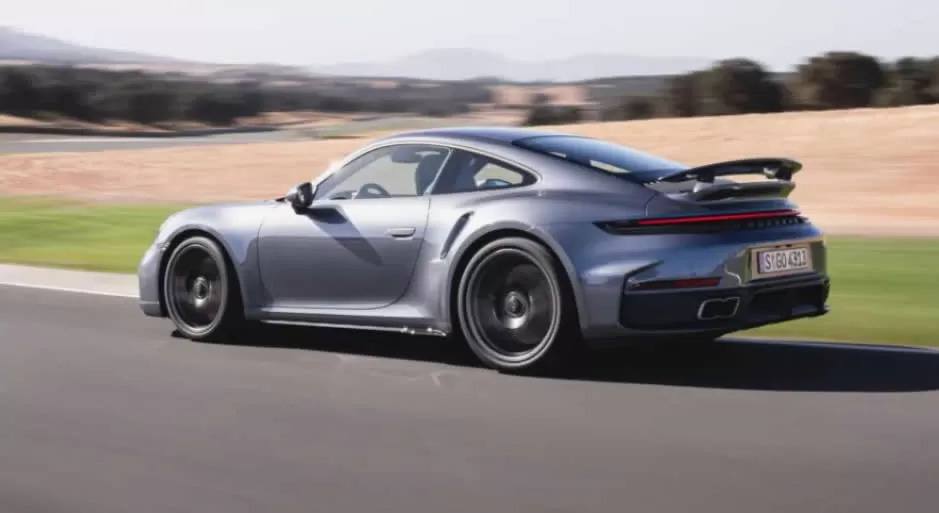
On March 12, the 2026 Porsche 911 Turbo S Hybrid completed its official performance testing. The vehicle achieved a 0–60 mph (0–96.5 km/h) acceleration time of just 2.0 seconds (including rollout)—a feat verified on March 10, 2026, by the authoritative publication *Car and Driver* using a high-precision VBOX satellite-based data logging system. This result currently stands as the fastest acceleration record for any mass-production vehicle worldwide.
This performance figure surpasses that of the Tesla Model S Plaid (2.1 seconds), the Rimac Nevera (1.8 seconds—though the latter is a limited-production electric hypercar), and the Chevrolet Corvette ZR1X (2.1 seconds), making it the first mass-production hybrid sports car to achieve acceleration within the two-second range.
This level of performance is not achieved through purely electric propulsion; rather, it is the result of the synergistic power unleashed by a combination of an internal combustion engine, an electric turbocharger, and an integrated electric motor—marking the ultimate evolution of Porsche's "T-Hybrid" technology.
|
Components |
Technical Specifications |
Innovation |
|
engine |
3.6L horizontally opposed six-cylinder twin-turbocharged engine |
Based on the Carrera GTS platform, the engine displacement has been increased from 3.0L to 3.6L, improving low-end torque response. |
|
Electric Turbo |
Dual electric turbochargers (one on each side) |
The turbine shaft integrates an 80kW motor, achievingzero-delay boostingwithout the need for a traditional pressure relief valve, and recovering exhaust energy to drive the motor. |
|
motor |
80 hp (60 kW) permanent magnet synchronous motor |
Embedded within an 8-speed PDK dual-clutch transmission, it directly outputs power with a response time of less than 50 milliseconds. |
|
Battery |
1.9kWh, 400V lithium-ion battery |
Located in the trunk, this lightweight design is intended for short-term high-power output only, not for pure electric range. |
|
System Overall Output |
701 hp (523 kW) |
Peak torque output range is 2300–6000 rpm, with no power interruption across the entire speed range. |
Traditional turbochargers require a waiting period for exhaust gases to spool up the turbine impeller; the T-Hybrid system, however, utilizes an electric motor to *directly drive the compressor*. This enables "instantaneous full boost the moment the throttle is applied," thereby completely eliminating turbo lag.
|
index |
numerical values |
Comparison and explanation |
|
0–60 mph |
2.0 seconds(including starting position) |
The fastest production car in the world, 0.4 seconds faster than the previous generation Turbo S. |
|
0–100 km/ h |
2.5 seconds |
Consistent with official data, it is 0.3 seconds faster than its predecessor. |
|
0–200 km/ h |
8.4 seconds |
0.5 seconds faster than its predecessor |
|
Top speed |
320 km/h |
Same as its predecessor, limited by aerodynamics and tire limits. |
|
A quarter mile |
9.5 seconds (estimated) |
Slightly slower than the Corvette ZR1X (9.2 seconds), reflecting Porsche's "launch priority" tuning. |
|
Nürburgring Nordschleife lap time |
7 minutes 03.92 seconds |
14 seconds faster than its predecessor, making it the fastest in the history of the 911 series. |
Porsche Brand Ambassador Jörg Bergmeister remarks: "You feel absolutely no increase in weight. On the contrary, this car demonstrates even greater agility and superior grip."
Curb Weight: Approx. 1,770 kg (Coupe version). Although the hybrid system adds approximately 80 kg, this increase has been offset through the following optimization measures:
Increased Use of High-Strength Steel: The A-pillars and side sills utilize hot-formed steel with a tensile strength exceeding 1,500 MPa;
Expanded Application of Aluminum Alloys: The front suspension, rear subframe, and hood are now constructed entirely from aluminum;
Structural Optimization: Elimination of traditional wastegates, simplification of the exhaust system, and the use of an integrated electric motor to reduce drivetrain losses;
No Carbon Fiber Bodywork: To manage costs and ensure everyday practicality, Carbon Fiber Reinforced Plastic (CFRP) is utilized only in select interior components and aerodynamic spoilers;
Drag Coefficient: Reduced to 0.28—a 10% improvement over the previous generation—thanks to an active air intake grille and optimized underbody airflow management.
|
system |
Function |
Technical Highlights |
|
PDCC Dynamic Chassis Control System |
Active anti-roll |
Driven by a 400V electrical system, its response speed is 30% faster than that of a hydraulic system. |
|
PTM All-Wheel Drive System |
Dynamic torque distribution |
The torque of the front and rear axles can be continuously adjusted from 0 to 100%, improving cornering stability. |
|
Carbon ceramic braking system |
Front 420mm / Rear 409mm |
Brake fade reduced by 40%, supporting continuous track driving |
|
PASM Active Suspension |
Adaptive Damping |
It can switch between "Comfort" and "Track" modes, catering to both daily commutes and extreme handling. |
|
Active rear-wheel steering |
Standard configuration |
Steering in the opposite direction at low speeds improves agility, while steering in the same direction at high speeds enhances stability. |
|
project |
Data submitted by the Ministry of Industry and Information Technology of China |
International version compatibility |
|
Model Name |
2026 Porsche 911 Turbo S |
911 Turbo S (992.2) |
|
Curb weight |
1770kg |
1770kg (hardtop) |
|
System overall power |
523kW (711 horsepower) |
523kW (701 horsepower, due to unit conversion differences) |
|
Battery Type |
Lithium-ion batteries |
1.9kWh, 400V |
|
Fuel type |
Hybrid |
Gasoline + Electricity |
|
Emission standards |
National VI |
Euro VI / EPA Tier 3 |
|
Warranty Policy |
3 years or 100,000 kilometers |
Globally unified 3-year unlimited mileage |
The declared specifications for the Chinese market are identical to those of the global version, confirming that this model has successfully passed all regulatory certification requirements in China.
|
User Profile |
Recommendation reason |
|
Track enthusiasts |
With a Nürburgring lap time of 7 minutes and 3 seconds, all-wheel drive, and carbon-ceramic brakes, it's a "street-legal race car." |
|
Tech Geeks |
Electric turbine + integrated motor + zero-delay response: a perfect fusion of internal combustion engine and electrification. |
|
High-end collectors |
Limited production, the most powerful 911 in Porsche history, with extremely high potential to become a classic. |
|
Everyday drivers |
The hybrid system allows for short-term pure electric driving (approximately 3km), providing a quiet and peaceful urban commute with lower fuel consumption than traditional V8 sports cars. |
"It wasn't born to break records; it was born to make every acceleration feel just as breathtaking as the very first one." — Top Gear, 2026 "Car of the Year" Owner Interview
The 2026 Porsche 911 Turbo S Hybrid is not designed to replace the internal combustion engine; rather, it serves as the most magnificent final flourish before that era draws to a close.
With a 1.9 kWh battery, it unleashes a ferocious output of 701 horsepower;
With electric turbochargers, it puts an end to the 50-year legacy of turbo lag;
With its integrated PDK and electric motor design, it elevates the synergy between mechanical and electronic systems to a level of unprecedented precision. This is not merely an "electric sports car," but the ultimate work of mechanical art—one that reinterprets the passion for driving through the lens of technology.